
Table of Contents
Voice fraud is not just a theory anymore. U.S. banks, fintech applications, telecom companies, and government organisations are all being aggressively targeted by deepfake audio, synthetic identity fraud, and AI-powered impersonation assaults.
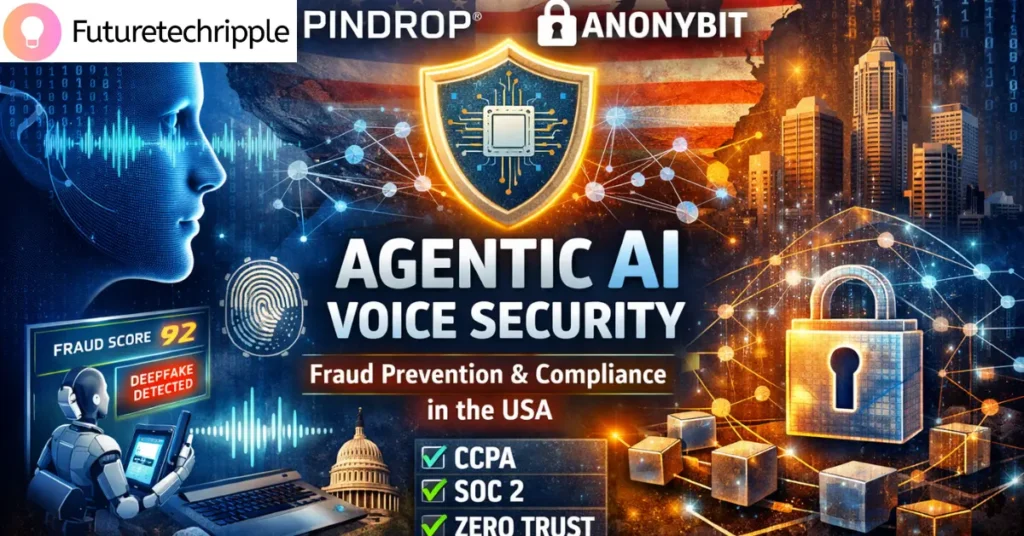
This is where the authentication landscape is altered by the combination of Agentic AI Pindrop Anonybit.
Collectively, they signify a change in direction towards:
- Self-sufficient fraud detection
- Voiceprint authentication in real time
- Biometric storage that protects privacy
- Identity management that follows Zero Trust
Let’s look at what this means, how it works, and whether or not it makes sense for your business.
Understanding Agentic AI Pindrop Anonybit in Voice Security
What is agentic AI?
“Agentic AI” is an artificial intelligence system that can make decisions and take action on its own, without needing constant input from people.
In contrast to conventional AI models that react to cues passively, agentic AI:
1.Real-time risk assessment
2.Modifies authentication procedures
3.automatically initiates step-up verification
4.learns from trends in fraud
It serves as an AI-powered decision-making tool in cybersecurity that constantly strikes a balance between user annoyance and security.
Pindrop: What Is It?
Pindrop is a voice security firm headquartered in the United States that specialises in deepfake voice identification, fraud detection, and voice biometrics.
It examines:
- Acoustic signatures of voices
- Call and device metadata
- Audio markers for the environment
- Biometrics based on behaviour
Pindrop is frequently used for account takeover mitigation and call centre fraud protection in telecom networks, insurance companies, and banking contact centres.
What is Anonybit?
Centralised biometric databases are eliminated using Anonybit’s decentralised biometric authentication.
Anonybit does not save complete biometric templates in a single database:
- divides biometric information into secure chunks.
- divides up storage across nodes
- Avoids breaches at a single point of failure
- encourages adherence to the CCPA and GDPR
The danger of a breach is significantly decreased by this decentralised biometric design.
The Significance of Agentic AI Pindrop Anonybit in 2026
AI for deepfake detection is now required. The accuracy with which synthetic voice cloning techniques can mimic speech patterns is startling.
American businesses deal with:
1.Examining FTC fraud enforcement
2.CCPA compliance requirements
3.An increase in instances of account takeover
4.Mandates for cybersecurity at the board level
Combining:
1.Pindrop (fraud scoring + voiceprint)
2.Anonybit (storage that protects privacy)
3.Autonomous orchestration, or agentic AI
builds a robust framework for identity verification that is in line with the Zero Trust design.
How the System Operates: Detailed
Step 1: Recording Voices
When a user accesses a voice-enabled system or makes a contact centre call:
- Acoustic signals are recorded.
- Voiceprint verification starts
- Data on device fingerprinting is gathered.
Step 2: Activation of the Fraud Scoring Engine
The platform for AI fraud detection assesses:
- Probability of deepfakes
- Signals of behavioural anomalies
- Patterns of synthetic identity
- Profile of historical risk
Milliseconds are used to score risk-based authentication.
Step 3: Decentralised Biometric Verification
Rather than using a centralised database query:
- Identity is verified using biometric shard storage nodes.
- There is no full biometric template available.
- Identity pieces are protected by encryption levels.
- This reduces breach culpability considerably.
Step 4: Orchestration of Agentic AI Decisions
The self-governing engine ascertains:
- Permit easy access
- Activate Multi-Factor Authentication (MFA)
- Increase to human review
- Completely block access
It adapts dynamically according to fraud statistics.
Step 5: Ongoing Education
Each workout makes you stronger:
- Accuracy of fraud modelling
- The capacity to identify deepfakes
- Profiling behavioural risk
Over time, the system becomes better.
Voice Biometrics vs Traditional MFA
| Feature | Voice Biometrics | Traditional MFA |
| Passwordless | Yes | No |
| Susceptible to phishing | Low | Medium |
| Deepfake detection | Yes | No |
| User friction | Low | Medium–High |
| Centralized risk | Avoidable (decentralized) | High |
Voice biometrics perform better than static MFA techniques when combined with deepfake detecting AI and decentralised identity verification.
Centralized vs Decentralized Biometric Storage
| Factor | Centralized Storage | Decentralized Storage |
| Breach risk | High | Lower |
| Regulatory exposure | Higher | Reduced |
| Data ownership | Vendor-controlled | Distributed |
| Compliance alignment | Complex | Simple |
The Zero Trust and NIST Digital Identity Guidelines frameworks are more in line with Anonybit’s concept.
Agentic AI Pindrop Anonybit: Who Should Use It?
Perfect for:
1.American credit unions and banks
2.Fintech companies
3.Insurance companies
4.Operators of telecoms
5.Networks of healthcare
6.Governmental organisations
Also pertinent to:
1.IAM services that integrate with Ping Identity or Okta
2.Businesses updating OpenID Connect and OAuth 2.0 flows
3.Businesses seeking ISO 27001 or SOC 2 certification
Fintech companies who handle sensitive data gain a lot from it, but SMBs could find it sophisticated.
Considerations for Regulation and Compliance (USA)
Businesses need to consider the CCPA’s biometric privacy regulations.
- Guidelines for FTC fraud protection
- SOC 2 audit specifications
- NIST confidence levels for authentication
In the USA, voice authentication compliance necessitates:
- Clear user consent
- Storage that is encrypted
- Clear guidelines for processing data
Compared to centralised systems, decentralised biometric design lowers regulatory vulnerability.
Modelling Deepfake Threats
Real-time AI voice cloning is one factor that modern synthetic voice detection must take into consideration.
1.Attacks by replay
2.The use of AI in social engineering
3.Attempts at hybrid human-AI fraud
By examining contextual cues in addition to voice acoustics, agentic AI enhances detection.
U.S. Voice Fraud & Deepfake Statistics
According to the FTC (Federal Trade Commission), Americans lost $10+ billion to fraud in 2023, with impersonation scams being one of the fastest-growing categories.
Financial institutions in the U.S. report that account takeover fraud has increased by over 30% year-over-year, largely driven by AI-enabled social engineering.
Industry cybersecurity reports estimate that deepfake-related fraud attempts in voice channels increased by 2–3x between 2022 and 2024, especially targeting banking call centers.
These numbers explain why AI-powered voice authentication is no longer optional for U.S. enterprises.
Example from the Real World: Deepfake Attack on a US Bank
Consider a scammer posing as a wealthy client phoning a U.S. bank utilising artificial intelligence (AI)-generated voice cloning.
Conventional system:
- Verified password
- sent an OTP
- The fraudster gets access
Using Agentic AI, Pindrop, and Anonybit:
1.Deepfake acoustic irregularities found
2.A discrepancy in behavioural patterns was found.
3.The risk score was immediately raised.
4.Step-up MFA was activated.
5.Prior to account takeover, access was prohibited.
As a result, the fraudulent effort was halted in milliseconds without interfering with authorised users.
Roadmap for Enterprise Integration
Phase 1: Evaluation of Risk
- Examine trends in fraud loss.
- Assess the friction associated with call centre authentication.
- Regulatory exposure map
Phase 2: Implementation of the Pilot
- Connect API endpoints
- Enrolment of test voiceprints
- Create a synthetic voice attack simulation.
Phase 3: Integration of IAM
- Link to current systems for identity and access management
- Comply with Zero Trust guidelines
Phase 4: Complete Implementation
- Train fraud teams
- Monitor fraud analytics dashboards
- Implement continuous governance reviews
Keep an eye on dashboards for fraud analytics.
- Typical voice biometric systems include:
- Enterprise licensing during the year
- Depending on demand, custom contracts can range from mid-five figures to high six figures.
Other expenses might consist of:
- Consulting for integration
- Customisation of APIs
Compared to cloud-native alternatives, on-premises deployments are more expensive.
Benefits and Drawbacks of Agentic AI Pindrop Anonybit
Real-time detection of deepfakes
1.shortened time for call centre authentication
2.Reduced losses from fraud
3.Storage that protects privacy
4.Alignment of Zero Trust
Restrictions
1.Enterprise-level costs
2.Complexity of integration
3.needs governance supervision.
4.Unsuitable for extremely tiny enterprises
Comparison of the Vendor Landscape
In addition to Agentic AI, Pindrop, and Anonybit, American businesses assess Nuance Communications
- Onfido
- The Jumio
- Identity of Ping
The majority of rivals concentrate on identity verification but lack complete agentic AI orchestration and decentralised biometric architecture.
Typical Implementation Errors
1.Considering voice biometrics to be independent security
2.Ignoring tests for synthetic voice detection
3.Not adhering to NIST guidelines
4.Decentralised storage models are not put through stress testing.
5.Ignoring privacy messages and user consent
Considerations for ROI and Fraud Reduction
Although fraud prevention differs by industry, American banks frequently use voice biometrics after:
- Increases in fraud incidents
- Audits of compliance
- Growing expenses for authentication support
Savings are derived from:
- Less time spent on manual verification
- Refunds for account takeovers are declining.
- Reduced overhead
Is it safe to use voice authentication?
Yes, in conjunction with decentralised storage and deepfake detection.
Simple voice recognition is not enough.
Advanced fraud scoring powered by AI is crucial.
Can AI Recognise Voices Produced by AI?
Indeed. Current models for detecting synthetic voices examine:
1.Inconsistencies in microacoustics
2.Anomalies in the spectrum
3.Patterns of behaviour
4.Metadata for the environment
Agentic AI, Pindrop, and Anonybit correlates contextual risk cues to improve detection accuracy.
FAQs about Agentic AI Pindrop Anonybit
Q1. In cybersecurity, what is agentic AI?
Autonomous AI that assesses risks and decides on security without continual human involvement is known as agentic AI.
Q2. What is the operation of voice biometrics?
It generates a voiceprint for verification by analysing distinctive vocal traits.
Q3. In the USA, is voice authentication secure?
Yes, as long as it complies with NIST and CCPA regulations and is backed by decentralised storage.
Q4. What distinguishes Anonybit?
Instead of utilising centralised databases, it uses encrypted shards to decentralise biometric data.
Q5. Is this technology suitable for small businesses?
Although it is mostly enterprise-focused, fintech businesses that handle sensitive data can utilise it.
Q6. What is the price of business voice authentication?
Depending on scale and deployment style, the yearly range is usually between mid-five and high six figures.
Q7. Is MFA replaced by this?
By providing risk-based, passwordless authentication, it may either strengthen or replace MFA.
Q8. Which sectors use this the most?
government organisations, banking, telecommunications, insurance, and healthcare.
In conclusion
Ultimately, should American businesses use this model?
Using Agentic AI, Pindrop, and Anonybit together offers a future-ready authentication architecture that is in line with Zero Trust principles for businesses dealing with deepfake threats, regulatory pressure, and an increase in voice fraud.
This model works best for:
- Credit unions and banks that deal with high-value transactions
- Fintech platforms that handle private information
- Telecom operators handling a high volume of calls
- Governmental organisations that need identity assurance that is in line with NIST
Instead of using voice biometrics as a stand-alone solution, businesses should start with a fraud risk assessment, carry out a trial deployment, and include it into a larger Zero Trust identification strategy.


