
Table of Contents
Introduction
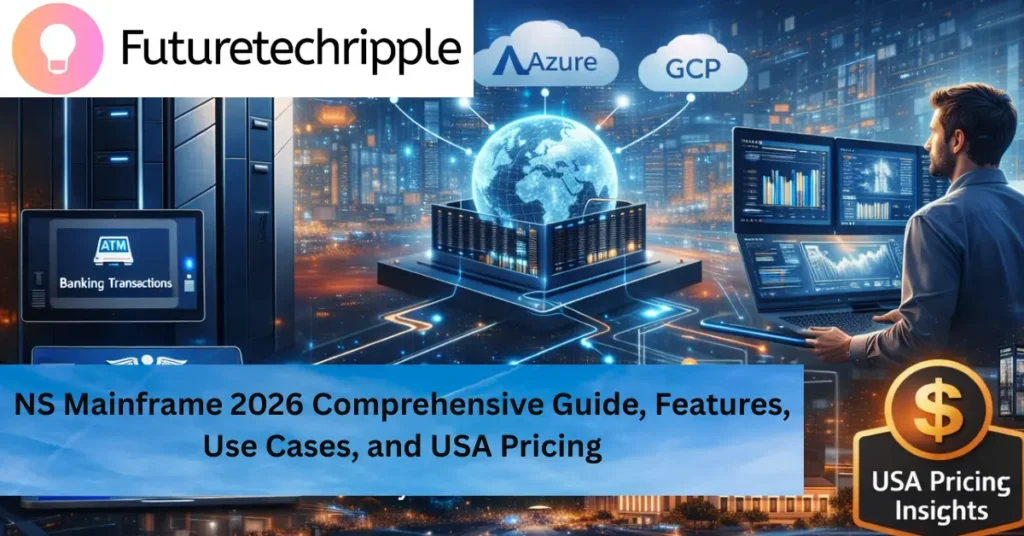
NS Mainframe is a high-performance computing platform made for businesses who need to handle mission-critical workloads. It assists businesses including banking, healthcare, government, and manufacturing by being reliable, scalable, and having improved security. In 2026, NS Mainframe still combines the stability of classic mainframes with the capabilities of current hybrid clouds and AI, enabling businesses run more efficiently while lowering risk.
This blog covers everything from architecture and variations to deployment tactics, price, and alternatives. It gives both IT decision-makers and small company teams looking at enterprise-grade solutions useful information.
What does NS Mainframe mean?
NS Mainframe is a strong business computing system that can manage a lot of transactions, complicated analytics, and applications that are very important to the business. It gives:
Reliability: 99.999% of the time, vital services are up and running.
Security: Following the rules of PCI DSS, HIPAA, ISO 27001, SOC 2, and GDPR
Scalability: It can handle millions of transactions at once.
Integration: Works with hybrid cloud configurations, APIs, and business apps
Banks and other financial organizations use it a lot.
- Hospitals and healthcare providers
- Agencies of the government
- Companies that handle logistics and manufacturing
Why NS Mainframe is Important
Even if cloud computing is becoming more popular, mainframes are still necessary for workloads that need:
High availability: processes that are always running with almost little downtime
Data integrity: Making sure that important information is correct and safe
Compliance: is following tight rules for audits and regulations.
Performance: Real-time analytics and AI integration that doesn’t have any lag concerns
Companies who use NS Mainframe get procedures that are easier to follow, lower operational risks, and infrastructure that can grow with their needs and support complex business ecosystems.
Components and architecture of the NS mainframe
A Look at the Hardware
Processing Units: Multi-core processors that work best when doing many tasks at once
Memory: Lots of RAM and a fast cache for operations with low latency
Storage: Different types of storage, such as SSD and NVMe
Software Stack
Operating system: NS OS 2026 with enhanced virtualization features as the operating system
Middleware: includes things like transaction managers, message queues, and enterprise connections.
Analytics and AI: working with machine learning and data pipelines
Integration Features
NS Mainframe works perfectly with:
- Cloud platforms like AWS, Azure, and GCP.
- Systems for ERP, CRM, and SCM
- Secure networked apps for processing transactions in real time
Different kinds and versions of NS Mainframe
| Variant | Use Case | Important Features | Perfect for Standard |
| Standard | Transaction processing | 24/7 uptime and moderate scalability | Banks of medium size and regional governments |
| Advanced | Analytics and AI for large amounts of data | Integration of many clouds, suitable for AI | Big banking and logistical companies that work across borders |
| Cloud | Deployments that are both | Integration of SaaS and PaaS, elastic scalability | Businesses that are moving to cloud-native operations |
How NS Mainframe Works
Workflow for processing data
- Taking in transactions from several sources
- Checking for errors, fraud, and real-time validation
- Processing with several computing threads
- Safe storage, reporting, and auditing
Safety and Compliance
- Encryption from start to finish and access depending on roles
- Following the rules (PCI DSS, HIPAA, ISO 27001, SOC 2, GDPR)
- Automated compliance checks built into processes
Combining Hybrid and Cloud
- Works with hybrid deployments with little delay
- Analytics, AI, and disaster recovery on the cloud
- Lets you automatically switch over and change the size of resources as needed
Use Cases for Businesses
1.Banking and Financial Services
- Finding and keeping an eye on fraud
- Reporting on compliance and being ready for an audit
2.Systems for Health Care
- Safe administration of electronic health records (EHRs)
- Analytics for hospitals and clinics that provide patient data in real time
- Telemedicine and monitoring patients from a distance
3.Government and the Public Sector
- Processing data from the census and population
- Systems for paying taxes and managing money
- Make sure that intelligence and defense data procedures are safe.
4.Making things and the supply chain
- Managing inventory and warehouses
- Forecasting and improving production
- Tracking logistics and using AI to analyze demand
Decision Framework: Is NS Mainframe the Best Choice for Your Business?
Step 1: Figure out how important and how much work you have to do
Step 2: Go over the rules and criteria for following the rules
Step 3: Figure out the budget and the overall cost of ownership
Step 4: Choose the kind of deployment (on-premises, hybrid, or cloud)
Step 5: Look at the options and see how well the seller supports them.
Pros and cons
Pros
- Very reliable and always up
- Can handle millions of transactions at once
- High security and following the rules
- Ready for hybrid cloud and AI integration
Disadvantages
- Higher fees up front and for running the business
- Needs IT worker with unique skills
- Not as flexible as cloud-native microservices
Prices and Deployment in the US
Pricing Ranges: Standard: $50,000–$150,000 per year
Advanced: $150,000 to $500,000 a year
Cloud: $10,000 a month or more (depending on consumption)
Deployment Notes
- National suppliers and regional integrators can help anywhere in the US.
- Providers that only work in New York, Chicago, and San Francisco
- Local prices might change depending on service contracts, training, and support at the customer’s site.
Common Errors and Dangers
- Not giving personnel training and certification
- Not doing hybrid-cloud integration testing
- Not paying attention to preparations for disaster recovery and failover
- Not knowing the whole cost of ownership
Other options besides NS Mainframe
IBM Z Series: Deep technical knowledge, focused on businesses
Fujitsu BS2000: structured deployment, clear diagrams, and fewer guidelines for transactions
Cloud HPC: technologies like AWS HPC and Azure Batch provide you the freedom of the cloud.
Best Ways to Put It into Action
- Do readiness checks before deployment
- Set up rules for governance and compliance
- Allow for automatic backups and monitoring in real time
- Use a hybrid-cloud design to make your system more flexible and scalable.
- Hire qualified vendors and engineers to make sure the deployment goes well.
Glossary of Entities
NS Mainframe: A computer system for businesses of all sizes
Transaction Processing: Running big business activities
Hybrid Cloud: Using both on-premises and cloud resources together
Data security and compliance standards are PCI DSS, HIPAA, ISO 27001, SOC 2, and GDPR.
Enterprise applications for running a business include ERP, CRM, and SCM.
Final Thoughts
In 2026, the NS Mainframe is still a key part of business IT, combining the durability of older systems with the flexibility of newer hybrid-cloud and AI technologies. It offers the best security, scalability, and compliance for managing financial transactions, healthcare records, or government data.
Organizations may get the most value out of their purchases while avoiding risk by looking at their workload demands, deployment type, price, and vendor support. For US businesses, city-specific providers and approved support make deployment more efficient, which makes NS Mainframe a smart choice for mission-critical computing.
People Also Ask (FAQs)
Q1.What does NS Mainframe do?
Processing a lot of transactions, doing analytics in real time, and using enterprise-level computing for mission-critical tasks.
Q2.What makes NS Mainframe different from cloud servers?
Compared to regular cloud servers, NS Mainframe offers more uptime, security, and dependability for mission-critical workloads.
Q3.What industries get the most out of NS Mainframe?
Banking, healthcare, the government, logistics, and manufacturing are some of these areas.
Q4.Can AWS or Azure work with NS Mainframe?
Yes, it works with hybrid cloud installations and can connect to the biggest cloud platforms.
Q5.What are the primary benefits of NS Mainframe?
Scalability, high availability, compliance with security standards, readiness for hybrid clouds, and integration with AI.
Q6.How much does NS Mainframe cost in the US?
Standard: $50,000 to $150,000 a year; Advanced: $150,000 to $500,000 a year; Cloud: $10,000 a month or more.
Q7.Are there more options besides NS Mainframe?
IBM Z Series, Fujitsu BS2000, and cloud HPC systems are also frequent choices.
Q8.What does it mean to have a hybrid-cloud NS Mainframe deployment?
It uses both on-premises mainframe resources and cloud computing to make things bigger, back things up, and add AI.
Q9.Who is in charge of NS Mainframe systems?
IT directors, system architects, and qualified mainframe engineers are usually in charge of deployment and operations.